In the wake of Corona confining us to our homes, I’m reviewing films I’ve never watched before and saying if they’re worth your time. In dangerous times, all we’ve got is our willingness to give a hoot about each other, and film is as good an educational tool as any
Friday, July 31, 2020
Ip Man (2008)
Spotlight (2015)
Thursday, July 30, 2020
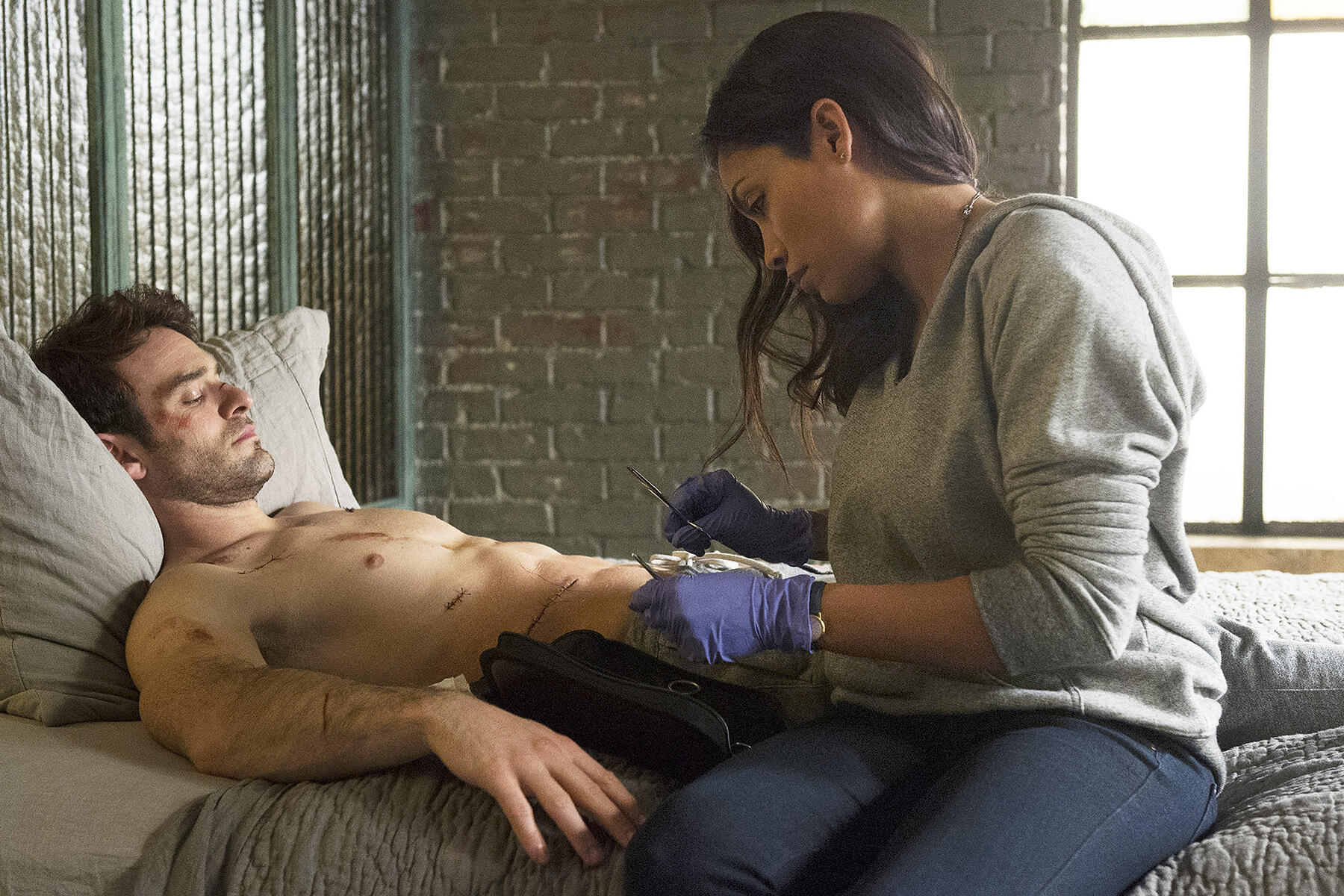
Daredevil: Season 1
It’s hard for me to write about Daredevil because we run into what I call the Uncanny Valley problem, but with TV.
The Uncanny Valley is a concept of human depiction. It says if you’re obviously not human, nobody minds, but if you’re mostly human and get just a LITTLE bit off, you’re going to freak people out a little. Compare C-3PO, for example, to Superman with his face obviously CGI’ed to hide his actor’s mustache. We’re fine with 3PO, ‘cause he’s MEANT to be a facsimile of a human face, not a realistic one, but a face that’s MEANT to look human but subtly isn’t is gonna creep us out.
That’s what I feel when I watch Daredevil. It tries harder to be realistic than a lot of live-action super-shows do, but that means when it’s unrealistic, you really feel how unrealistic it is. It’s to the point where it might’ve been better off going for C3PO. So 50% of the time watching Daredevil I’m so there for what’s happening and the other 50% of the time I’m so annoyed ‘cause I can see how fake this all is. That’s why I’ve never written about it, even though I love superhero stories and have seen tons.
That said, Season 1 is the closest to being flawless. Got a great reception, established the universe well, did a GREAT job with the characters it introduced. The Kingpin and Daredevil both get acclaim for being amazingly cast, scripted, and acted.
I specifically remember three moments in the pilot that convinced me this was gonna be a good show:
- The opening speech in the confessional, which feels like the kind of opening you’d see in a play
- The chirpy “What time is it?”, “Half past get the heck up!” exchange soon after, which established a good sense of humor
- The scene near the end where we see Daredevil’s apartments night is bathed in a red neon glow from a billboard across the street, soaking his apartment in atmospheric, comic-book style color with an in-universe justification and an explanation of how he can rent such a nice apartment. That was just *Italian chef kiss*work right there.
Those alone did a lot of work to keep me watching. The other moments in the next episodes that cemented the loyalty was worked on that stuff. And it shows.
But, weak points?
Well, I’m not going to go into detail, but the Karen Page character here always annoys me, ‘cause she feels like a reverse Chuck Cunningham character, who always gets the guys around her killed and then is all sad about it, while then doing nothing to change what brought about their deaths in the first place. Like a honey trap, but with vulnerability instead of sexiness. And then it feels like they try to make her a Lois Lane-type character, but that doesn’t work when Lois Lane is still always crying about how she failed or something. This will continue to frustrate.
And secondly, Daredevil BFF Foggy Nelson’s hair will always annoy the heck out of me - you’re a law graduate! You should have a permanent haircut figured out by now! And it should be a good one! To be fair, by the time of Defenders he has figured out a permanent cut and it looks great, so I’ll give it a future pass, but it still annoys me here.
And finally, and the biggest actual problem - pacing. I feel like these shows would have benefited from a ten-episode season instead of thirteen, because thirteen forty-five minute increments is long enough where you start having to stretch the story out. There’s always something in each season that feels a little longer than it has to be. In Season Two, it’s the Blacksmith plot. In Season Three, it’s the Bullseye business. In this, it’s the whole business with the Russians, which feels like it spends three episodes fleshing out side characters and then killing them off. Also, the foot-dragging with the real Daredevil costume. The first season gets an excuse ‘cause they probably wanted a cool reveal in the last episode, but that they have the hero wear jeans and Lycra for all the season and then get the absolute tar beaten out of him on several occasions feels like plot that could’ve been avoided if they just started giving him the suit sooner. This is also an ongoing issue that I’ll be revisiting later, but suffice it to say, it’s emblematic of a larger problem.
But overall, these are small complaints. The show has great atmosphere, great takes on its characters, and great fight scenes, and those are things that will never really decline with the show’s run, and it deserves major props for that consistency. Well done. Loved it. 9/10
Monday, July 27, 2020
An Argument in Favor of Scorsese
The argument that's made about Scorsese films quite often is that his films make criminality look too cool and thus encourage the very thing they're supposed to be condemning. He's pushed the envelope in terms of violence and crime and language in film, and been criticized for it, but he's said that he believes audiences can get the message that criminality is wrong by watching the film, and that they're smart enough to understand the message for themselves.
How true is this?
Well, I'd argue it's essentially true, but also kind of complicated.
The first big problem is marketing. Films have to market themselves as exciting, and that frequently means you can end up with the opposite message of the film being displayed in the marketing. I'd argue, for example, that Wolf of Wall Street's marketing did more to encourage the irresponsible playboy image than the film itself, 'cause the film itself had several notable scenes of him going off the rails, but none - of - the trailers had that! The nature of the marketing is you can't have the whole product, so you just lie and show the most attractive parts. And from there, we can say an image of evil or irresponsibility or criminality is projected into the consciousness. But that's not the same as saying the film itself did that.
The second point is, some subjects are probably inherently VERY difficult to conventionally condemn. It's been argued that there's no such thing as a true anti-war film, 'cause there'll always be SOMEONE in the audience who sees all the violence and thinks it's cool, and I'd argue that applies to crime films as well. Look at all the criminals who imitated The Godfather and Scarface. Those are both tragedies, but clearly that's not enough! That's not to say an anti-X film is impossible; I'd argue that Eastern Promises and Das Boot both come a lot closer to reaching that than a lot of others; but it's very difficult. You have to accept there's a degree of accuracy that will always be a bit off.
And point the third is, if we're totally honest, Scorsese films do always feel like they spend most of their runtime showing how cool criminality is. But the truth is, that's how he's made these films popular. There's a million films about criminal careers going off the rails, and we haven't heard of most of them, because they were probably pretty boring. Excitement allows the films to reach wide audiences. And from there, he genuinely does show that crime doesn't pay in the end, so he's kind of honey-trapping all audiences - luring them in with a shiny exterior only to reveal an unpleasant reality underneath. So he's really doing what most people accuse him of NOT doing!
There's a whole bunch of discussions that could be had about this, but the baseline statement worth saying is that while Scorsese is by no means some moral exemplar or an example of most ethical filmmaking or anything, he's not actively pro-crime. And his grasp of story and tragedy has arguably conveyed the ugliness of criminality a lot better than most of his peers, so you can hate him if you want, but he's by no means a moral deep end in the entertainment world.
--
There's more that can be said about this subject, but that's all I'm gonna say for now. Discussion welcome
Thursday, July 23, 2020
The Old Guard (2020)
Directed by: Gina Prince-Bythewood, based on the graphic novel by Greg Rucka
Starring: Charlize Theron, Chiwetel Ejiofor, Dudley freaking Dursley, and Kiki Layne
This feels like a film I would’ve rented when I was nine not knowing what it was, and then thought was great ‘cause I didn’t have any frame of reference for good action films. It feels average; okay action, all right drama, and it kiiind of explores the premise in an interesting way. I’d recommend it if you’re a Charlize Theron fan and don’t mind seeing some violence, but outside of that it’s not really appealing.
Premise - a squad of immortal warriors in the modern day find themselves under attack at the same time a new initiate for their order is discovered. They struggle to defeat their attackers while saving their newest family member, and potentially facing their own deaths.
Charlize Theron is decently charismatic. The rest of the cast is decently written. Action movies tend to either overdo the violence, underwrite the characters, or badly write the plot, but this managed to balance everything to the point where it feels like a legitimate story, instead of an excuse for stuntmen to beat each other up a few times. It’s violent, but it doesn’t revel in it like a lot of action films do. It’s dramatic, but it doesn’t wallow in the sadness like other dramas do, and it explores some historical questions, but not the way historical films usually do.
Wednesday, July 22, 2020
Pirates of the Carribbean: Curse of the Black Pearl
Starring: Johnny Depp, Orlando Bloom, Keira Knightley, Geoffrey Rush
After discussing how Prince of Persia tried to launch an adventure franchise but failed, I wanna talk about Pirates of the Caribbean (the first entry) and how it successfully launched a franchise because it was so darn good.
The big difference between Prince and Pirates - because they both have the same sense of action, directing, music, costuming, pacing, and are produced by the same studios - is that Pirates mixed up the character dynamics. They really did something that was unusual with the Will Turner - Jack Sparrow - Elizabeth Swann trio. And like Prince it isn’t spinning its wheels, it feels like it’s actually trying to say something meaningful. But the difference is that while most characters in Prince were pretty interesting, the central duo of Prince and Princess were not. It was rom-com slap/kiss basic-ness. In contrast to Orlando Bloom’s pining or Elizabeth’s drama or Sparrow’s wild card energy, it feels pretty meh. Hence, Pirates succeeded and Prince did not.
Black Pearl is SUCH a good film, though. It’s only fault is that it’s a little long (2 and a half hours), but that’s not really a fault when the film is good. It does what so many films (including its own sequels) fail to do, which is have a silly-feeling tone, but take the characters’ struggles deadly seriously, and let them guide the plot where it needs to. A lot of funny things happen TO the characters, but they themselves never make light of their struggles. Jack Sparrow’s bravado, for example, is always about getting people distracted so he can get something from them. He’s not just practicing his tight five.
Will and Sparrow also embody that kind of Han and Luke duo that pops up in stories. They're two different stages of maturity; Will serving as the young ingenue (and therefore audience surrogate), and Sparrow as the cocky mentor who shows him the ropes. You add that in to Keira Knightley (whom I would argue is essentially living a Pride & Prejudice plot - "how do I rise above the unambitious goal of simply making a good marriage") and you have a plotline from each of them that dazzles by itself and electrifies with the others. Throw in the ham-tastic Captain Barbossa, and you end up with a knock-out story that frikkin' kills it.
Sunday, July 19, 2020
Pop Culture Hot Take - We Like Serial Killers Because ...
I was on a film shoot today (↑) where someone referred to our location as a serial killer’s den, and it reminded me of all the reasons the American occurrence of serial killers and our subsequent interest in them is misconstrued or used to demonize Americans. I'm sure there's plenty of legitimate points there, but I think there's a core to our fascination that legit makes sense. Hence the hot take.
First thing to make clear, serial killers are just ... the worst. Seriously. I don't know how much detail all the documentaries and movies and special episodes go into, but read a Wikipedia page for most any serial killer and you'll find they were just some a-hole who wanted to hurt people. Even adding in bad childhoods and possible mental disorders and all the other factors, it eventually boils down to "this guy wanted to hurt people, and then he did, usually many times." They are NOT Sympathetic Bad Guys. They are bad guys who long since crossed the line and need to be dealt with as quickly as possible.
So, why do we have all these forms of media around serial killers (besides the obvious potential for drama)? Why do we have a subculture of actively discussing the most despicable and unworthy of being imitated people in history? Well, I've decided ... it's because serial killers have qualities we admire. Not handsomeness or whatever. On a personal level, serial killers are fascinating because they usually have three qualities we admire.
--
One, they're self-sufficient. They have to be able to keep their dark side hidden and that requires all sorts of scheming that makes them more autonomous. We like seeing that quality in people.
Second, they're good at blending in. They have to hide who they are, and like when we watch James Bond or Jason Bourne escape the cops, we admire someone's ability to blend in when the heat is on.
And third of all ... they're hunters. They know how to hunt things down and obtain them. They know how to analyze and track and swoop in for the kill. And that's something we like too! Even when the victims don't deserve it. Hunting is how humanity progressed into civilization, and we still deign to notice when someone is good at it.
--
So, the truth is that serial killers, while practicing despicable crimes, are doing so with some of the most fundamentally admirable traits in human memory. And that disgusts us, because we're busy being disgusted by them. But we ARE noticing those qualities! And so we're stuck in a contradictory space where we'll hate that person with all our might, but the smallest part of us is wondering how they do what they do, and if there comes a chance to learn about that on TV, we'll take it!
There's more to the issue than this, but I think that explains a lot of it. I think it's easy to be judgemental and say "people like looking at serial killers 'cause they think they're cool", but I think people have enough moral development to understand they're bad. People keep producing TV about serial killers because they're dark mirrors of what we like most, not just the worst of the worst. And as to the other question, "why are there more serial killers in America than there are anywhere else?" Well, the truth is, other countries don't track serial killers as much. And there are a number of countries that are more violent or unstable than the US. So maybe serial killers are just a luxury of living in places where we keep track of murders, have a decent quality of life, and don't have violence on a day-to-day basis. Food for thought